QUICK ANSWER Botox is a brand of botulinum toxin type A, a prescription medicine that temporarily reduces the activity of selected...
How to Know If Your Child Needs Glasses: A Guide for Ghanaian Parents
Your child has never complained about their eyes. They seem happy at school, active at home, and nothing has flagged up at a health check. So the question — does my child need glasses? — probably hasn’t crossed your mind.
But here’s the problem with that logic: children don’t know what they’re missing. A child who has always had blurry distance vision has nothing sharper to compare it to.
They won’t tell you the board is hard to read because, to them, that’s simply what the board looks like. They won’t describe their vision as impaired — they’ll just squint, sit closer, lose concentration, or fall behind.
In Ghana, research suggests that approximately 90% of childhood vision loss is avoidable, with uncorrected refractive error — the kind that glasses fix — being the leading cause. Most of those children are sitting in classrooms right now, undiagnosed.
| KEY STATISTIC — GHANA Only 13.3% of school children in one Ghanaian study had ever had an eye examination before screening, despite a significant proportion having untreated refractive error. |
This guide is for every Ghanaian parent who wants to know the signs. Not the obvious ones — a child who says ‘I can’t see’ — but the subtle behavioural signals that often go unrecognised for years.
Why Your Child Won’t Tell You Their Vision Is Poor
Adults know what sharp vision feels like. When our eyesight changes — from driving at night, from a screen session, from natural ageing — we have a reference point. We notice the difference.
Children don’t have that reference point. If a child has had blurry distance vision since age six, blurry distance vision is their normal.

They have never experienced clarity, so they have nothing to report as lost. This is why refractive errors in children are so consistently underdiagnosed: the child isn’t concealing a problem; they genuinely don’t know one exists.
What they do show are compensatory behaviours — automatic adjustments the visual system makes to deal with unclear images. These are the signs parents and teachers need to know.
9 Signs Your Child May Need Glasses
Watch for these behaviours consistently — not once, but across multiple settings (home, school, outdoors). A child who shows two or three of these signs over several weeks deserves a formal eye examination.
| # | Sign to Watch For | What It Means & What to Do |
|---|---|---|
| 1 | Squinting frequently | Squinting temporarily sharpens vision by reducing scattered light. If your child squints to see the TV, the classroom board, or distant objects, they are compensating for blurred distance vision. This is the most common visible sign of myopia (short-sightedness). |
| 2 | Sitting very close to screens or books | Children who are myopic bring objects close to enlarge the image and improve apparent clarity. If your child sits within 30 cm of the TV or holds their phone unusually close to their face, investigate further — especially if this is a habit rather than an occasional occurrence. |
| 3 | Frequent headaches after school or reading | When the eyes are working harder than they should to focus — particularly in children with astigmatism or hyperopia (long-sightedness) — the extra muscular effort causes headaches, typically at the front of the head or behind the eyes. Headaches that resolve over weekends but return during the school week are a key pattern to notice. |
| 4 | Excessive eye rubbing | Occasional eye rubbing is normal. Persistent rubbing during reading, homework, or close work suggests eye strain or fatigue. The child is trying to temporarily relieve the discomfort of overworked focusing muscles. |
| 5 | Tilting the head or covering one eye | Head tilting adjusts the angle at which light enters the eye — a common compensation for astigmatism. Covering one eye suggests the child sees better through one eye than the other, which can indicate amblyopia (lazy eye) or significant prescription difference between the two eyes. Both warrant immediate assessment. |
| 6 | Losing their place while reading | Children with unaddressed refractive error or binocular vision problems (where the two eyes don’t work together properly) frequently lose their place mid-sentence, skip lines, or re-read the same line. This is often misinterpreted as dyslexia or an attention problem. |
| 7 | Declining school performance | Vision is responsible for approximately 80% of what children learn in a classroom. A child whose grades are slipping — especially in tasks involving the board, reading, or written work — may be unable to see clearly enough to engage fully. Academic underperformance is not always about effort or ability. |
| 8 | Sensitivity to light or complaints about glare | Excessive light sensitivity (photophobia) — especially in bright sunlight or fluorescent classroom lighting — can indicate a variety of vision conditions. If your child frequently squints or closes their eyes in normal lighting, have their eyes checked. |
| 9 | Eyes appear crossed or wandering | Visible misalignment of the eyes — one turning inward, outward, or seeming to ‘wander’ — is a red flag requiring prompt specialist assessment. Strabismus (misaligned eyes) and amblyopia (lazy eye) can cause permanent vision loss in the affected eye if untreated before age 7–8, when the visual pathway is still developing. |
| URGENT: BOOK IMMEDIATELY IF YOU NOTICE THESE One eye consistently turns inward or outward. A white or pale reflection in the pupil in photos (instead of red-eye). Sudden vision change or complaint of seeing double Eye pain, discharge, or significant redness not related to seasonal dust Head tilting that has started suddenly rather than gradually |
What Eye Conditions Are We Actually Talking About?

The signs above are symptoms. The underlying conditions they point to are:
Myopia (Short-Sightedness)
The most common refractive error in children globally. Distant objects appear blurry; near objects are clear.
Myopia is increasing in prevalence worldwide, including in Ghana, linked partly to more time on screens and less time outdoors. It is corrected with glasses (concave lenses) and typically progresses through the school years, stabilising in adulthood.
Hyperopia (Long-Sightedness)
Near objects appear blurry; the eye has to work harder to focus, causing eye strain and headaches. Young children can compensate for mild hyperopia by over-focusing, making it invisible to parents — but the compensatory effort still causes fatigue.
Moderate to severe hyperopia requires glasses to prevent amblyopia.
Astigmatism
The cornea is not perfectly round, causing blurred or distorted vision at all distances. Often accompanies myopia or hyperopia.
Research from Ghana found astigmatism prevalence of 6.6% among school children — the most common refractive error identified in some Ghanaian studies. Corrected with cylindrical lenses in glasses.
Amblyopia (Lazy Eye)
One eye develops weaker vision because the brain begins to ignore its input — often due to a significant prescription difference between the two eyes, or strabismus. The visual pathway is ‘plastic’ only until around age 7–8.
After that, amblyopia becomes very difficult to treat. This is why early detection is critical: treated before age 6, outcomes are excellent; left untreated into adolescence, the vision loss may be permanent.
Strabismus (Crossed or Misaligned Eyes)
The eyes do not point in the same direction. Can be intermittent (comes and goes) or constant. Causes amblyopia if untreated. Treatment includes glasses, eye patching, and in some cases surgery. Again — the earlier the better.
The Ghanaian Reality: Why So Many Children Go Undiagnosed
If the signs are well-documented and the conditions are treatable, why do so many Ghanaian children sit through years of school with uncorrected vision?
No routine school screening programme
Unlike some countries where vision screening is integrated into the school health system, Ghana does not yet have a standardised national school eye health programme. A child can complete primary school without ever having had a formal eye examination.
Children don’t complain
As established earlier, they adapt, they compensate, they don’t know what they’re missing.
Parents misread the signs
Headaches are blamed on the sun, on heat, on malaria. Squinting is seen as habit. Poor grades are attributed to attitude or effort. The connection between these behaviours and vision is not widely made.
Cost and access concerns
A mistaken belief that eye examinations are expensive or that glasses are unaffordable keeps many families from seeking care. A comprehensive paediatric eye examination at a specialist facility is an accessible investment — and NHIA covers it for insured patients.
| COST REALITY FOR GHANAIAN PARENTS A specialist paediatric eye examination at St. Thomas Eye Hospital is NHIA-covered for insured patients. Prescription glasses are available at the optical dispensary within the facility — no separate trip required. Children’s frames are stocked at a range of price points. Early correction is significantly cheaper than the educational remediation required when vision problems are caught late |
What Happens During a Children’s Eye Examination?
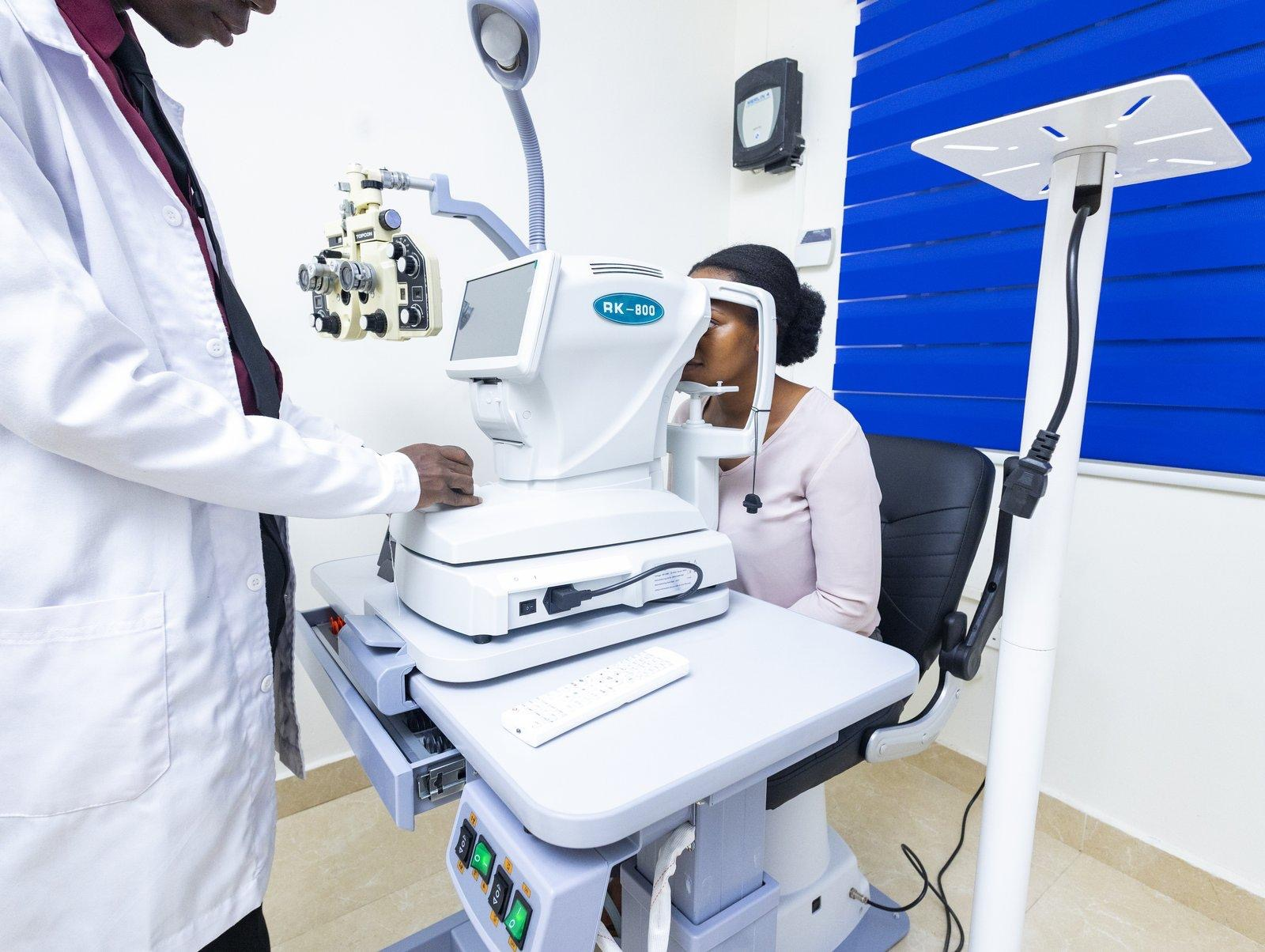
Many parents delay examinations because they don’t know what to expect — or worry their young child won’t be able to ‘perform’ the test. Here is what actually happens:
The examination does not depend on a child being able to read
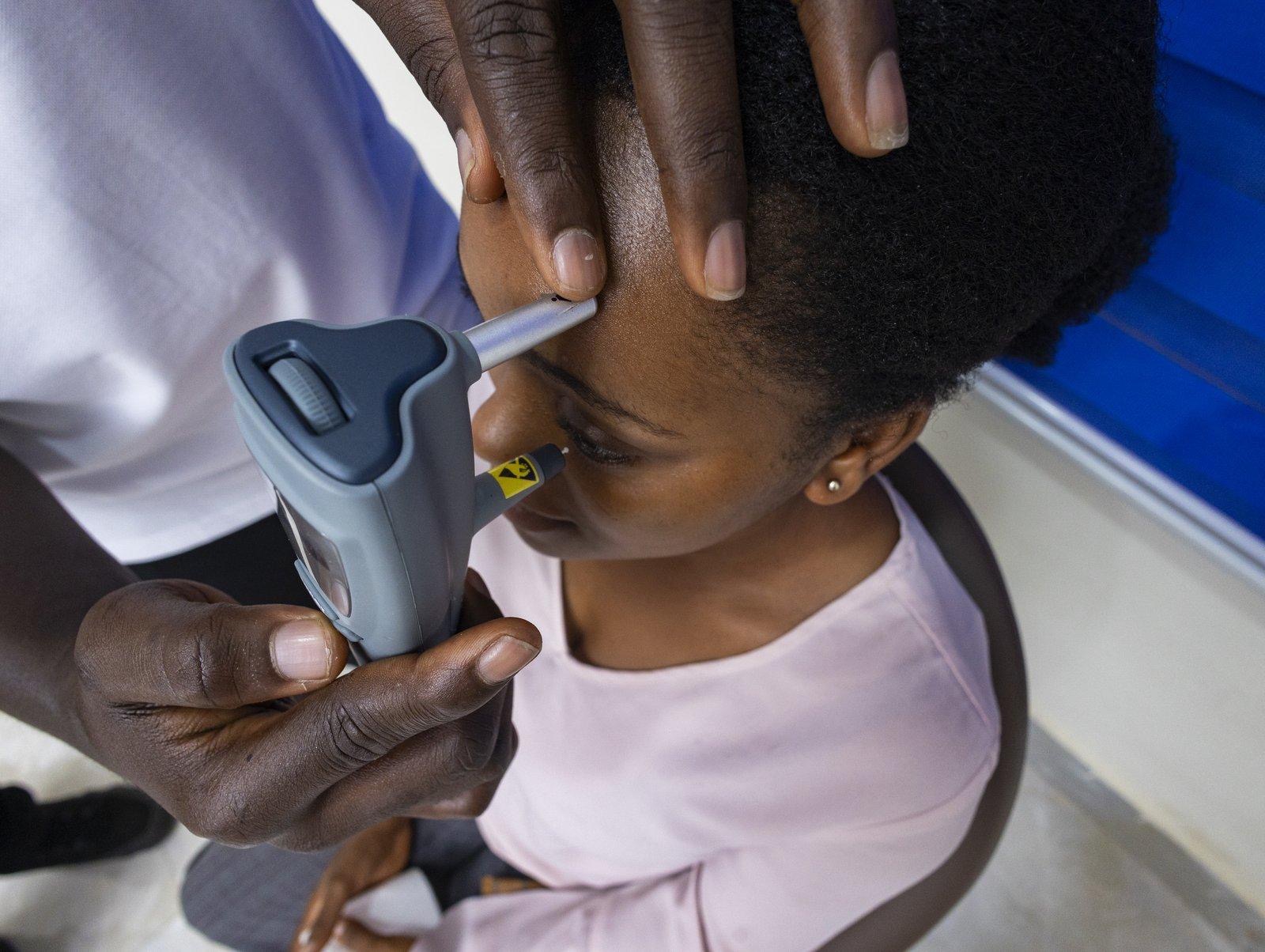
Even for pre-literate children, eye examinations use picture-based or shape-based tests (rather than letter charts), light reflexes, and objective measurements with instruments. An experienced paediatric eye specialist will adapt the examination to the child’s age and cooperation level.
What is assessed
Visual acuity: How clearly can the child see at distance and near?
Refraction: Is there a prescription (myopia, hyperopia, astigmatism)?
Binocular vision: Do the two eyes work together properly?
Eye alignment: Are there signs of strabismus?
Eye health: Examination of the front and back of the eye, including the optic nerve and retina.
Cycloplegic refraction in young children
In young children (typically under 8), the specialist may recommend a cycloplegic refraction — where eye drops are used to temporarily relax the eye’s focusing muscles, allowing an accurate measurement of the full prescription.
This is especially important for hyperopia, which young children can mask by over-focusing. The drops cause temporary blurring and light sensitivity for a few hours; this is normal.
When Should My Child Have an Eye Examination?

This is the recommended schedule for Ghanaian children, based on the Ghana Health Service’s own guidance and standard paediatric ophthalmology practice:
| Age Group | When to Check | What Is Being Assessed |
|---|---|---|
| At birth / newborn | Before leaving the hospital | Red reflex test — checks for basic eye structural problems |
| 6–12 months | Eye alignment, light response, and early cataract detection | Myopia, astigmatism, and amblyopia — academic performance is affected at this stage |
| Before starting school (age 4–5) | Required before KG or Primary 1 | Visual acuity, focusing, eye alignment — catch problems before literacy begins |
| Primary school age (6–12) | Every 1–2 years | Myopia, astigmatism, amblyopia — academic performance is affected at this stage |
| Secondary school age (12–18) | Every 1–2 years, or more if myopia is progressing | Myopia progression monitoring, screen-related strain |
Outside of this schedule, book an examination immediately if you notice any of the warning signs described in this article — or if a teacher raises concerns about your child’s ability to see the board.
A Word on Glasses and Children in Ghana
One barrier that rarely gets named but frequently delays care is the social perception of glasses for children. In some Ghanaian communities, wearing glasses can feel stigmatising — associated with weakness, illness, or being ‘different.’ Children themselves sometimes resist glasses because they fear teasing.
It is worth naming this directly and pushing back on it. Glasses do not weaken the eyes. A child does not become ‘dependent’ on glasses in a harmful way — they simply see clearly with them and less clearly without them. The goal is always clarity.
A child who can see the board learns more. A child who can read without a headache reads more. The academic and social confidence that comes from corrected vision is not trivial, they are the foundation of educational performance and self-esteem through the most formative years of a child’s life.
| WHAT TO TELL YOUR CHILD ABOUT GLASSES Glasses help your eyes work less hard — like wearing shoes helps your feet. Many successful, admired people wear glasses — you are in good company. You don’t have to wear them all the time — your doctor will advise when they’re needed. The right frame can feel good — bring your child to choose. If teasing happens, address it with the school — this is a health issue, not an aesthetic one |
What to Do If You Suspect Your Child Has a Vision Problem
The steps are simple:
- Note down the specific behaviours you have observed and how long they have been occurring.
- Ask your child’s teacher if they have noticed anything in class — concentration, proximity to the board, or copying problems.
- Book a comprehensive eye examination at a specialist paediatric eye facility. Not a pharmacy eye test or a quick vision chart check — a full specialist examination.
- Bring your NHIA card. The examination is covered for insured patients.
- If glasses are prescribed, collect them from the optical dispensary on-site and monitor your child’s comfort and school performance over the following weeks.
St. Thomas Eye Hospital sees children of all ages across its branches in Accra (Osu, Mataheko, Labadi), Tema, Kumasi, and Takoradi. Walk-ins are welcome, and specialist paediatric eye assessments are available without a referral.
The Bottom Line for Ghanaian Parents
Your child’s eyes are quietly doing something extraordinary — taking in information, processing images, supporting reading, writing, and learning, from the moment they wake up until they fall asleep. Most of the time, you will never notice a problem because children compensate so effectively.
What you can do is watch for the signs, take them seriously, and book an examination before a problem becomes a pattern and a pattern becomes a handicap.
A child who sees clearly learns more easily, reads more willingly, and grows up with a foundation they deserve. That foundation starts with one appointment.
Frequently Asked Questions
At what age should my child first have an eye test in Ghana?
The first eye check should happen before a child starts school — ideally between ages 3 and 5, or earlier if you notice any symptoms. The Ghana Health Service recommends eye examinations every two years from age 20, but for children at risk, examinations should begin earlier and occur more frequently.
Can a child outgrow the need for glasses?
In some cases of mild hyperopia (long-sightedness), young children’s eyes do sometimes improve as the eye grows and the shape normalises. However, myopia (short-sightedness) typically does not improve on its own and often progresses through the school years. Astigmatism is generally stable. Your specialist will advise based on your child’s specific prescription and age.
Will wearing glasses make my child’s eyes weaker?
No. This is a widespread misconception. Glasses correct refractive error — they do not change the eye itself. A child who wears glasses does not develop worse vision because of the glasses. The prescription changes because the eye continues to develop, not because glasses were worn.
How do I know if my child needs glasses or just needs to sit closer to the board?
Sitting closer to the board is itself a sign that your child needs glasses. A child with normal vision can see a standard classroom board clearly from any seat in a typical Ghanaian classroom. If your child consistently seeks the front row or complains about seats further from the board, that is a referral-worthy symptom.
My child passed the vision screening at school — does that mean their eyes are fine?
Not necessarily. School-based vision screenings typically test only basic distance visual acuity using an eye chart. They do not assess near vision, binocular vision, eye alignment, focusing ability, or eye health. A child can pass a screening and still have a meaningful refractive error, early amblyopia, or an eye health condition. A comprehensive specialist examination is more thorough.

Dr. Michael E. Gyasi is the Medical Director and founder of St. Thomas Eye Hospital — a multi-branch specialist facility that introduced phacoemulsification cataract surgery and micro-incisional vitrectomy surgery to Ghana. Under his leadership, the hospital has delivered over 10,000 free sight restoration surgeries and screened more than 200,000 people for eye disease across the country.