QUICK ANSWER Botox is a brand of botulinum toxin type A, a prescription medicine that temporarily reduces the activity of selected...
Top 3 Jobs That Quietly Wreck Ghanaian Eyesight
By Dr. Akosua Mensah-Bonsu
Ophthalmologist, St. Thomas Eye Hospital

Long hours on Ghana’s roads carry real, cumulative eye health risks. Alt text: commercial driver eye health Ghana occupational hazard.
Nobody puts “eye damage” on a job description. But for a significant share of working Ghanaians, it belongs there.
If you spend your working life behind a windscreen, behind a market stall, or behind a welding mask, your eyes are absorbing cumulative damage that most people never connect to their job — until the day it shows up as a diagnosis.
This article looks at three of the largest occupational groups in Ghana — commercial drivers, market and street traders, and outdoor/manual workers — and the specific, evidence-based eye risks tied to each.
Commercial Drivers: Colour Vision, Accidents, and a Legal Requirement You Can’t Ignore
A study of 520 commercial vehicle drivers in Ghana’s Central Region, published in the Journal of Optometry, found a direct link between colour vision deficiency and road traffic accident involvement. Drivers with red-green colour vision defects (protanopia) were significantly more likely to have been involved in a crash.
This matters because colour vision deficiency is something many drivers simply don’t know they have. It doesn’t feel like anything is wrong — you’ve always seen colours “your way.” But on the road, misjudging a traffic light, brake light, or warning sign by a fraction of a second has consequences.
The Legal Dimension
Ghana’s Driver and Vehicle Licensing Authority (DVLA) enforces Regulation 29 of the Road Traffic Regulations, 2012 (L.I. 2180), which requires every applicant for a learner’s licence, driver’s licence, or licence renewal to pass an eye test administered and certified by a registered ophthalmologist or optometrist. The minimum standard is binocular vision of 6/12 (20/40), along with an adequate visual field.
This isn’t a formality. According to recent DVLA figures, of 251,117 drivers tested, 32,645 initially failed — nearly 13%. Almost 4,900 were ultimately denied a licence due to uncorrected vision problems. Many of these drivers had been operating vehicles for years with vision impairments they didn’t know they had.
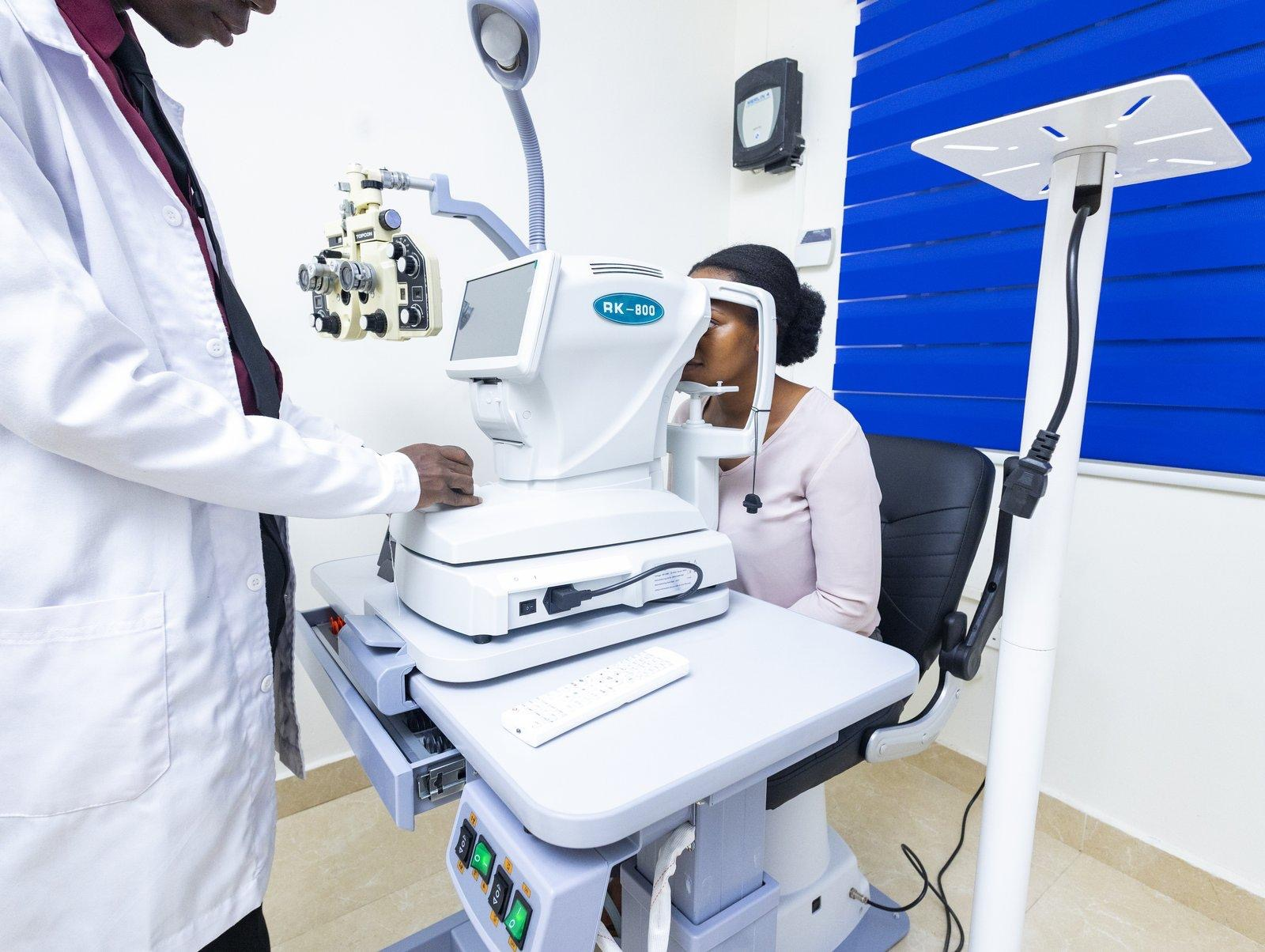
St. Thomas Eye Hospital is equipped to perform and certify DVLA driver’s licence eye testing at our branches, covering visual acuity, colour vision, and visual field requirements in a single visit.
Beyond the legal minimum: Long hours of driving, particularly in Ghana’s dense urban traffic, also cause cumulative eye strain, dry eye from air conditioning and dust exposure, and increased UV exposure through the windscreen. If you drive for a living, an annual comprehensive eye exam — not just the DVLA minimum — is worth the time.
Market and Street Traders: Sun, Dust, and a Working Environment with No Protection Built In
A WIEGO study of market and street traders in Accra and Takoradi documented a working environment with little structural protection from the elements — traders spending entire working days exposed to direct sun, dust, vehicle exhaust, and heat with minimal shade or protective infrastructure.

Outdoor market trading in Ghana involves prolonged daily sun and dust exposure. Alt text: market trader outdoor eye health Ghana UV exposure.
The specific eye risks for outdoor traders accumulate over years, not days:
• Pterygium — a growth of tissue across the white of the eye, strongly linked to chronic UV exposure. We’ve previously written about this condition; it remains one of the most common reasons outdoor workers present to us. A pterygium that grows toward the cornea can eventually affect vision and requires surgical removal.
• Accelerated cataract formation. UV-B exposure is a well-established risk factor for cataracts, and research on outdoor workers globally consistently shows earlier cataract onset in populations with high lifetime sun exposure — a category that includes most Ghanaian market traders.
• Chronic dry eye and irritation from constant dust and wind exposure, particularly along roadside trading locations.
• Foreign body injuries from dust, debris, and airborne particles kicked up by passing traffic.
Practical protection is simple and inexpensive: a wide-brimmed hat or umbrella for shade, UV-blocking sunglasses (even basic ones provide meaningful protection), and prompt attention to any foreign body sensation rather than rubbing or self-treating with unverified eye drops. We cover this and other risks in our hub article: 6 Reasons Ghanaians Go Blind — and Why None of Them Have To, which addresses corneal opacity from trauma and traditional remedies.
Outdoor and Manual Workers: Construction, Welding, and Agriculture
Construction workers, welders, farmers, and labourers face some of the most acute (immediate, injury-based) and chronic (long-term, cumulative) eye risks of any occupational group.
Acute risks: Foreign body injuries from dust, metal fragments, or wood chips are common and, left untreated, can lead to infection or corneal scarring. Welders face a specific and severe risk: photokeratitis (“arc eye” or “welder’s flash”) — essentially a sunburn of the cornea caused by UV radiation from the welding arc.

It typically presents hours after exposure as intense pain, light sensitivity, and a gritty sensation, and is entirely preventable with proper welding shields.
Chronic risks: Cumulative UV exposure across decades of outdoor labour mirrors the risks seen in traders — pterygium and earlier cataract formation — compounded by higher rates of direct eye injury from tools, machinery, and agricultural chemicals.
Chemical exposure deserves particular mention. Splashes from fertilisers, pesticides, or industrial chemicals can cause severe corneal burns. The single most important action after any chemical eye exposure is immediate, prolonged irrigation with clean water — at least 15–20 minutes — before seeking further care.
Do not wait, and do not apply traditional remedies or unverified substances to the eye, which can worsen chemical injuries significantly.
What All Three Groups Have in Common
Across drivers, traders, and outdoor workers, a few principles hold consistently:
1. Protection is cheap; treatment isn’t. Sunglasses, hats, and welding shields cost a fraction of what cataract surgery, pterygium removal, or corneal injury treatment costs — in money, time off work, and long-term vision.
2. Symptoms often show up years after the exposure that caused them. A pterygium or early cataract diagnosed at 45 may be the cumulative result of two decades of unprotected sun exposure starting in a person’s 20s. This delay is exactly why occupational risk groups benefit from earlier and more frequent screening than the general population.
3. Annual screening matters more for these groups, not less. If your job places you in any of the categories above, we recommend a comprehensive eye examination every 12 months, rather than the every-two-years interval generally recommended for the broader adult population. Catching a pterygium, early cataract, or colour vision issue early keeps your treatment options simpler and your livelihood protected.
Get Screened, Get Certified, Get Protected
If your work fits any of the categories in this article, book a comprehensive eye examination at any of our four branches — Mataheko, Osu, Tema, and Kumasi. If you need DVLA certification specifically, our team can complete the full required testing and provide certified results in a single visit.
Your eyesight is the tool you use to do your job, every single day. It’s worth protecting on the same schedule.
St. Thomas Eye Hospital offers comprehensive eye examinations and certified DVLA driver’s licence eye testing across all four branches. View all our services →
Related Reading
• What That Eye Scan Actually Shows: A Plain-English Guide to Eye Diagnostic Tests
• 6 Reasons Ghanaians Go Blind — and Why None of Them Have To
• Eye Care in Tema: What a Landmark Local Study Reveals
• Contact Lenses vs. Glasses in Ghana

Dr. Michael E. Gyasi is the Medical Director and founder of St. Thomas Eye Hospital — a multi-branch specialist facility that introduced phacoemulsification cataract surgery and micro-incisional vitrectomy surgery to Ghana. Under his leadership, the hospital has delivered over 10,000 free sight restoration surgeries and screened more than 200,000 people for eye disease across the country.
Tags :