QUICK ANSWER Botox is a brand of botulinum toxin type A, a prescription medicine that temporarily reduces the activity of selected...

6 Reasons Ghanaians Go Blind: And Why None of Them Have To
By Dr. Michael Gyasi
Medical Director, St. Thomas Eye Hospital
With contributor credits to Dr. Joe Kwarteng, Dr. Daisy Asiamah, and Dr. Akosua Mensah-Bonsu
Ghana has a blindness problem. And the frustrating part is that most of it doesn’t need to happen.
According to the World Health Organisation, approximately 80% of all visual impairment globally is either preventable or treatable. In Ghana, the six conditions driving the highest rates of avoidable blindness are all conditions that respond to treatment, if caught early enough.
The problem isn’t that treatments don’t exist. It’s that most Ghanaians never get screened until symptoms force them to. By that point, conditions like glaucoma have already caused irreversible damage, cataracts have matured beyond simple surgery, and diabetic retinopathy has progressed to a stage where only emergency intervention can limit further loss.
This article is a reference document. It covers all six major causes of preventable blindness in Ghana: what they are, who’s most at risk, what the warning signs look like, and what treatment is available — including what we offer at St. Thomas Eye Hospital across our four branches.
1. Cataract
What it is: The natural lens inside the eye gradually becomes cloudy, causing blurred vision, faded colours, and increased sensitivity to glare. It’s the leading cause of blindness in Ghana and across sub-Saharan Africa.
Who’s at risk: Everyone, eventually. Cataracts are primarily age-related and affect most people over 60 to some degree. However, they develop earlier and progress faster in people with diabetes, those who spend significant time in direct sunlight (outdoor workers, market traders, farmers), and individuals with a history of eye injury or steroid medication use.
Is it treatable? Yes, and very effectively. Cataract surgery is one of the most commonly performed and successful surgeries in the world. At St. Thomas Eye Hospital, we perform both sutureless small-incision cataract surgery and phacoemulsification (laser cataract surgery), replacing the cloudy lens with a clear artificial lens.
We’ve covered this in depth: Cataract Surgery in Ghana: What Patients Ask Most, Answered by Eye Specialists.
2. Glaucoma
What it is: A group of diseases that damage the optic nerve, the cable connecting the eye to the brain. It typically starts by destroying peripheral (side) vision and progresses inward until central vision is lost. The damage is irreversible.
Who’s at risk: Ghana has the highest glaucoma prevalence in Africa. Approximately 8% of Ghanaians over 30 are affected. Risk increases with age, family history, African descent (which applies to the entire population), and elevated intraocular pressure.
The disease is often called the “silent thief of sight” because it causes no pain and no symptoms until significant, permanent damage has occurred.
Is it treatable? The damage already done cannot be reversed. But progression can be slowed or halted with eye drops, laser treatment (SLT), or surgery. The earlier it’s caught, the more vision is preserved.
Read more: 5 Things Most Ghanaians Get Wrong About Glaucoma and Eye Drops, Laser, or Surgery? Understanding Your Glaucoma Treatment Options.
3. Uncorrected Refractive Error
What it is: Myopia (short-sightedness), hyperopia (long-sightedness), and astigmatism (conditions where the eye’s shape prevents light from focusing correctly on the retina). These are not diseases. They are optical imperfections.
Who’s at risk: Everyone. Refractive errors are the most common eye conditions in the world. In Ghana, the problem isn’t that glasses don’t exist, it’s that millions of people who need them don’t know they need them, can’t access testing, or can’t afford appropriate lenses.
Is it treatable? Completely. A simple refraction test identifies the exact prescription, and glasses or contact lenses correct the vision immediately. This is the most cost-effective intervention in all of eye care.
Our optical services include refraction, spectacle fitting, and a fully stocked optical shop at all branches. We’ve also compared the options: Contact Lenses vs. Glasses in Ghana: Which Is Right for You?

Precision lens verification at the St. Thomas Eye Hospital optical lab.
4. Diabetic Retinopathy
What it is: Diabetes damages the small blood vessels in the retina over time. In the early stages, the vessels leak or swell. In advanced stages, the retina grows fragile new blood vessels that can bleed or cause the retina to detach. It’s the leading cause of blindness in working-age adults globally.
Who’s at risk: Every person with diabetes, type 1 or type 2. Ghana’s diabetes prevalence has risen from 0.2% in 1964 to over 6% today, according to data published in PMC. Research from Accra and Kumasi shows that approximately 18% of Ghanaian diabetics already have retinopathy at first examination.
Is it treatable? In early stages, good blood sugar control can halt progression entirely. In later stages, PRP laser treatment, anti-VEGF injections, and vitrectomy surgery can stabilise vision and prevent blindness — but cannot fully restore vision already lost.
Full patient guide: If You Have Diabetes in Ghana, Your Eyes Are Already at Risk
5. Corneal Opacity
What it is: Scarring or clouding of the cornea — the clear, dome-shaped front surface of the eye. It can result from infections (bacterial, viral, or fungal keratitis), injuries (chemical splashes, foreign objects, farming accidents), traditional eye medicine (herbal or chemical substances applied directly to the eye), or complications from untreated conditions like trachoma.
Who’s at risk: Outdoor workers, farmers, construction workers, and anyone exposed to dust, plant matter, or chemical hazards. People who use traditional eye remedies — which can cause severe chemical burns to the cornea — are at particular risk. Children in rural communities are also vulnerable due to limited access to prompt medical care for eye injuries and infections.
Is it treatable? Prevention is the first line: wearing eye protection, avoiding traditional remedies applied to the eye, and seeking prompt treatment for any eye injury or infection. For established corneal opacity, corneal transplant surgery is sometimes possible, though access to donor tissue remains limited in Ghana.
6. Childhood Blindness
What it is: A cluster of conditions that cause visual impairment in children, including congenital cataracts, childhood glaucoma, amblyopia (lazy eye), strabismus (squint), retinopathy of prematurity, and uncorrected refractive errors.
Who’s at risk: A 2025 IOVS study found that 34% of schoolchildren screened in Kumasi had at least one ocular disorder. The vast majority had never been examined. Ghana currently has no mandatory school eye screening programme, leaving detection to parents and teachers.
Is it treatable? In most cases, yes, if caught early. Amblyopia responds to patching and glasses if treated before age seven to nine. Childhood cataracts can be surgically removed. Refractive errors are corrected with glasses. The challenge is that late detection turns treatable conditions into permanent disability.

Our full guide for parents: Your Child’s Teacher Said They’re Struggling to Read the Board. It Might Be Their Eyes
A fully equipped slit lamp examination suite at St. Thomas Eye Hospital.
What Does an Eye Screening at a Specialist Hospital Actually Involve?
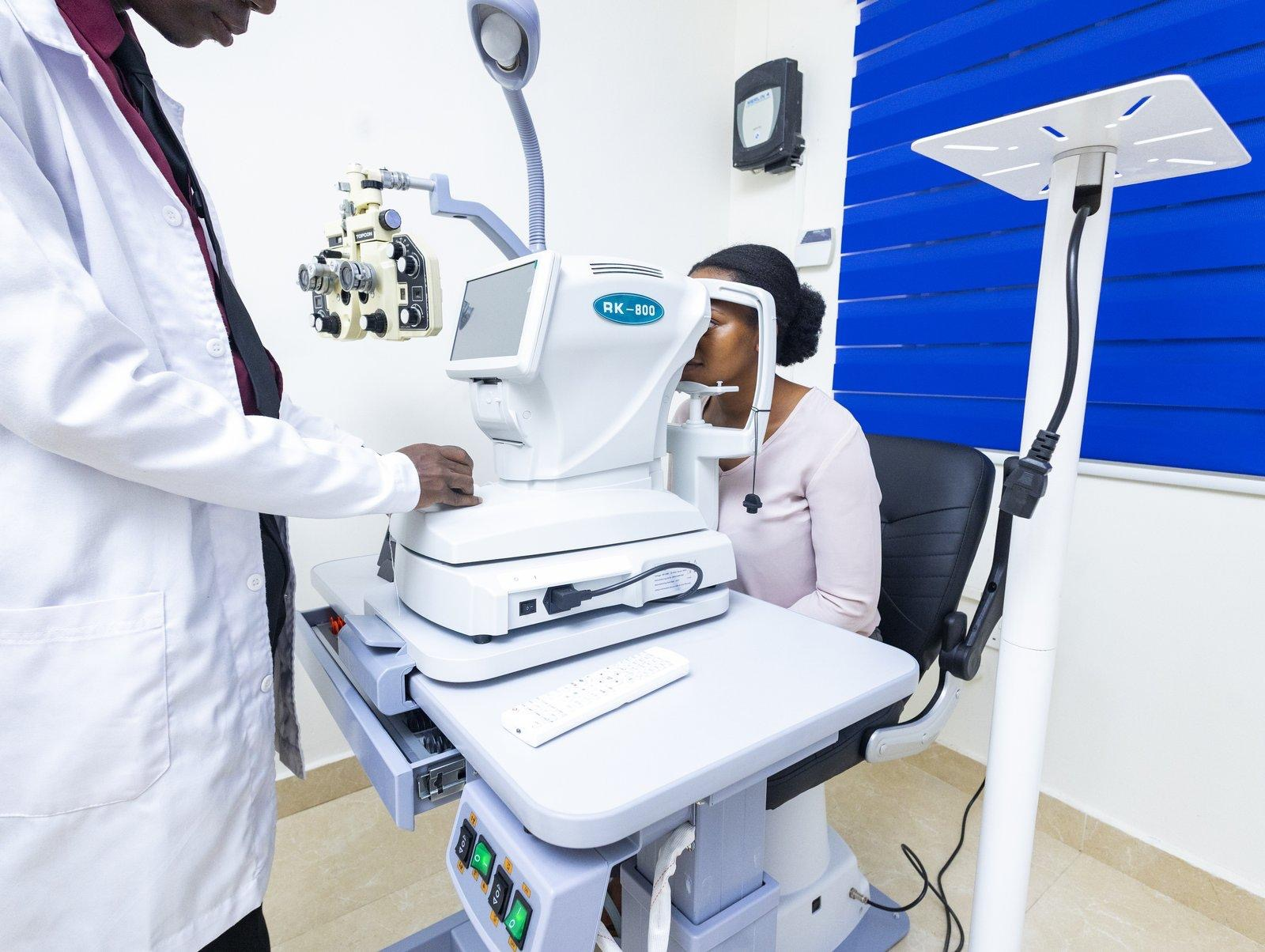
If you’ve never had a comprehensive eye examination, here’s what to expect at St. Thomas Eye Hospital. The process takes approximately 30 to 45 minutes.
Visual acuity test: You read letters or shapes from a chart at a set distance. This measures how sharp your vision is at various distances.
Refraction: Using a phoropter or trial frame lenses, the examiner determines whether you need glasses and, if so, the exact prescription.
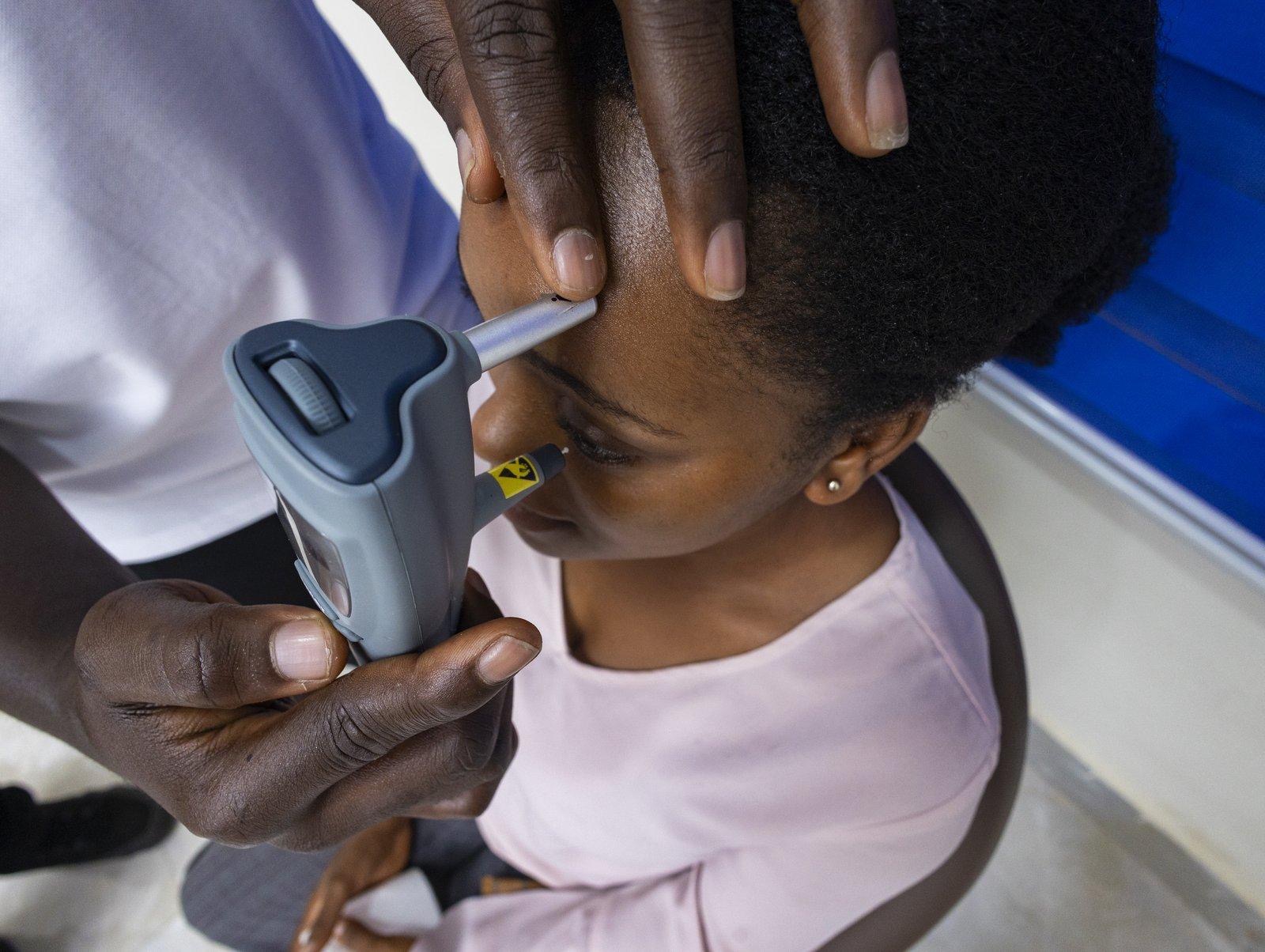
Intraocular pressure (IOP) measurement: Using a non-contact tonometer (the “puff of air” test) or an applanation tonometer. Elevated pressure is a key risk factor for glaucoma.
Slit lamp examination: A microscope with a focused light source allows the ophthalmologist to examine the cornea, iris, lens, and anterior chamber of the eye in fine detail.
Dilated fundus examination: Drops are applied to widen the pupil, allowing the ophthalmologist to examine the retina, optic nerve, and blood vessels at the back of the eye. This is the only way to detect early-stage glaucoma, diabetic retinopathy, and retinal tears.
After dilation, your vision will be blurry for two to four hours. Bring sunglasses and arrange transport — do not plan to drive yourself home.
Who Should Be Getting Screened, and How Often?
Every adult Ghanaian over 40 should have a comprehensive eye examination at least every two years, even with no symptoms. Over 60, annually.
Every person with diabetes should be screened every 12 months, starting from the date of diagnosis. If retinopathy is already present, every three to six months.
Anyone with a family history of glaucoma should start screening at age 30 or earlier. Glaucoma is strongly hereditary, and early detection is the only way to preserve vision.
Every child should have their first comprehensive eye examination between ages three and five, before starting school.
Anyone experiencing symptoms — blurry vision, eye pain, flashes of light, sudden floaters, a dark shadow in their vision — should be seen immediately, regardless of age.
What St. Thomas Eye Hospital Is Doing About Preventable Blindness in Ghana
St. Thomas Eye Hospital was established in 2010 with a specific mission: to make specialist ophthalmology accessible to Ghanaians who would otherwise not have access to it.
Today, the hospital operates four branches — Mataheko, Osu, Tema, and Kumasi — staffed by board-certified ophthalmologists who perform the full range of clinical, laser, and surgical eye procedures.
Key initiatives include:
NHIA accreditation across all branches, ensuring that basic ophthalmology consultations and diagnostic services are accessible to insured Ghanaians.
International training partnerships with institutions including Tufts University and visiting vitreoretinal surgeons from Brazil, which have built local surgical capacity — particularly in retinal surgery and advanced glaucoma procedures.
Community outreach and screening programmes that extend the hospital’s reach beyond its physical locations into underserved communities.
Patient education through this blog, covering the most common questions Ghanaians have about their eyes in language that is clear, accurate, and grounded in local context.
Book Your Screening
If you’ve read this far, the next step is straightforward: book an appointment.
If you are over 40 and have never had a comprehensive eye examination, book one. If you have diabetes, book one. If you have a family history of glaucoma, book one. If your child has never been screened, book one.
The six conditions in this article are all treatable. But only if they’re caught.
St. Thomas Eye Hospital is a multi-branch specialist ophthalmology centre serving Ghana and the West African sub-region. Our team includes fellowship-trained surgeons, experienced ophthalmologists, optometrists, and optical professionals across four locations. View all our services →

Dr. Michael E. Gyasi is the Medical Director and founder of St. Thomas Eye Hospital — a multi-branch specialist facility that introduced phacoemulsification cataract surgery and micro-incisional vitrectomy surgery to Ghana. Under his leadership, the hospital has delivered over 10,000 free sight restoration surgeries and screened more than 200,000 people for eye disease across the country.
Tags :